
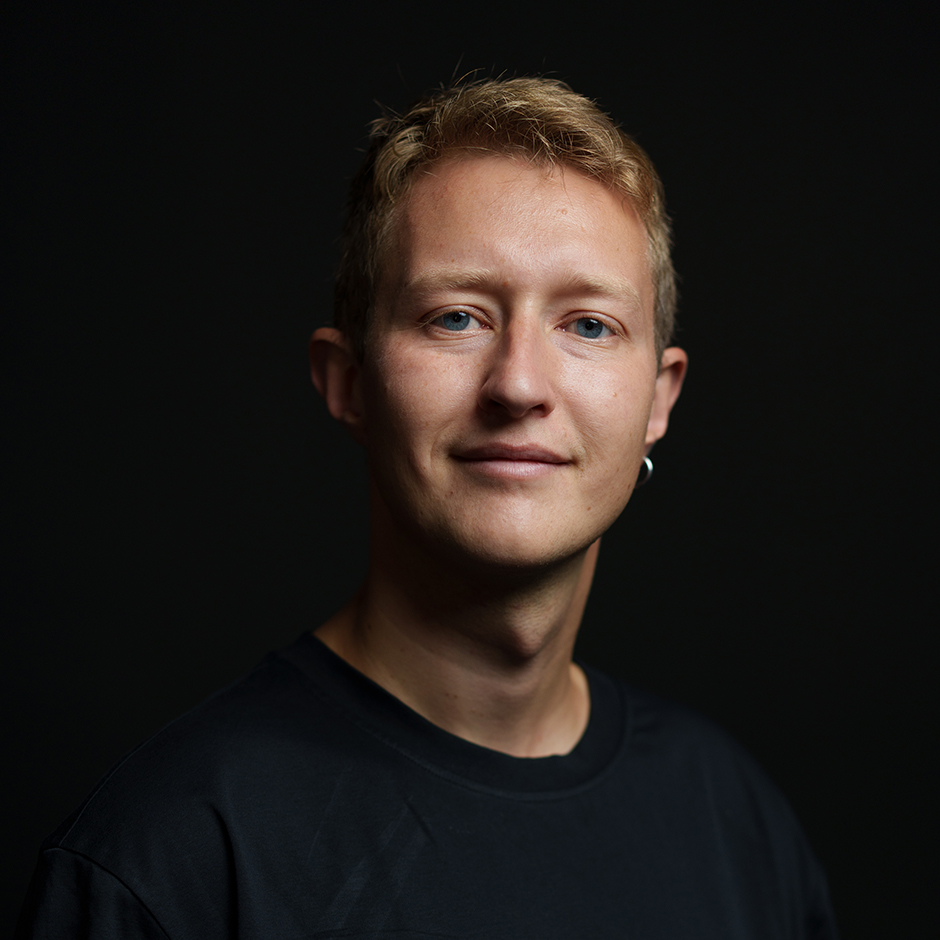
Serhii Korovayny
Interview by
David Stuart
Serhii Korovayny is a Ukrainian photojournalist currently covering the Russian Ukrainian war. In his projects, Serhii focuses on conflict, environmental issues and refugees, among others.
Serhii is a frequent contributor to the Wall Street Journal and has also worked with Time, the Washington Post, Spiegel, The Guardian, and the Financial Times.
As a Fulbright Scholar, Serhii received his MA in Photography at Syracuse University, NY, USA. In 2022, Serhii received a James Foley Award for Conflict Reporting. In 2024, he participated in the Joop Swart Masterclass by World Press Photo. In 2025, his works received awards from POYi and NPPA.
Serhii's works were showcased at multiple personal and group exhibitions in Ukraine and worldwide.
I want to ask you about your new book, “Love Letters to Donbas,” now that we have it in hand, but first tell me, when did you start taking photographs and what made you decide to become a photographer?
The first photograph in the book is of me in 2009. My parents took the photo, and it was probably near that time that I took my first photographs, about 13 or 14 years old. I did photography as one of many other things. It wasn't my priority at all, but it was a hobby and I did a lot of it. When I moved to Kyiv for university, I gave it up as a hobby. When I came back to photography, it was professional photography. I thought,” I want to try to be a photojournalist.” It was 2014, amid the Maidan revolution in Kyiv and then war in the East. So I responded with photography. I met people who were photojournalists and I liked their example. My photos weren’t great but it was my first approach to photojournalism.
You were at university in Kyiv when the Russians first invaded Donbas. How did the Russian invasion affect you personally?
I visited by hometown, now occupied by the Russians, adorned with Russian flags and with constant propaganda and did my first real project about life there. I wasn’t really a photojournalist yet but, when I went back to dig through my archive in preparation for the book, I found some very nice work, some before the Russians arrived. After ten years of occupation, the images evoke nostalgia and the work now is unique in showing life before Russia took complete control. This early work forms the core of my book.
Where I'm from in eastern Ukraine, our identity was very ambiguous. Everybody spoke Russian. People didn’t think of themselves as pure Ukrainians. Everybody lived in the Soviet Union. It was the same country and a shift to truly Ukrainian identity just didn't happen. And in my generation, we didn't talk about politics a lot, and, when it came to university, we could choose to go to Kyiv, Donetsk, Sevastopol or Moscow. All the options were open.
I went to Kyiv and, of course, it changed me. My surroundings, my environment, became much more Ukrainian. I had friends from Western Ukraine with very clearly articulated Ukrainian European values. We didn't talk about it at the time, but I felt it. And then Maidan started. I didn't participate fully, which I'm a bit ashamed of now. But I started to ask who am I? It was a kind of quiet inner evolution to becoming a regular Ukrainian citizen.
When Yanukovich fled and Russia first annexed Crimea and then, very quickly, invaded my hometown, that was a decisive moment. There was endless Russian propaganda about Ukrainians attacking Russian people, bombing babushkas and the like. The Russians flooded our media space with all kinds of propaganda. But I remember thinking clearly, “It’s not Ukrainian troops in Rostov and the people from Rostov can't go to their homes.” I couldn’t go to my hometown freely. I had to go through checkpoints with armed militia. So, I understood that Russia was to blame. And I finally identified myself as Ukrainian.
With limited access to your home, you went on to explore other parts of the Donbas region. What did you find?
My last visit to my hometown was in the spring of 2016. I already felt it was super dangerous and uncomfortable to be there with Russian flags and armed troops walking around. I didn’t feel safe or free to go wherever I wanted, so I stopped going there. At that time, I had started to do photojournalism. I did an internship and then worked at Radio Free Europe. War continued in eastern Ukraine, a slow kind of war, but it was still a region of interest. So, I just started to do assignments there with Ukrainian and European media. I did a little on the military situation but mostly I focused on how people live near the front line, how people live in war. I photographed winter, coal mines and even music festivals.
I was visiting the region more and more for work and I fell in love with it. Not only because it's my place of birth, but there was a feeling that a new Ukraine modern, sovereign and powerful was being born and raised there. There Ukrainian army was fighting Russians. They called them separatist but there were also Russians. But businesses were open and there was a lot of investment and a lot of social projects in the frontline areas. Some NGOs came there and did work for places like O.E.C. or UN agencies. So, there was a feeling that something was brewing in this region.
And just like a new Ukraine was being born there, I can say my feeling about being Ukrainian was also born there. The landscapes, the smells, sea and plains, the mills, all the things that I knew from childhood, grew into my understanding of the modern and interesting process my country was going through. So, it's an incredibly valuable region for me and I just traveled there more and more.
After university, I went to United States to do master’s degree at Syracuse University in New York. I did my master’s project about Mariupol, and it became a pretty big story. It was about the environment, because Mariupol had two steel plants and the worst air quality in Ukraine. So, I did story about this and the people living there. Of course, I also did some smaller stories around Donbas, from photographing children to visiting frontline positions.
Then, when the full-scale invasion started and Mariupol became like hell on earth and all of it was destroyed, I was showing photographs of air pollution, the plants and the people there. Of course, these plants became the last strongholds for Ukrainians. So now these earlier pictures have become much more meaningful and interesting in a different context. I didn't photograph them at the time with this feeling, but then it just happened because many of these places just don’t exist anymore. And, as I said, they also became the ones of my book.
“I cannot stop the advance of the Russian army. What I can do is take pictures. This is my way to preserve memory. Let this book be a naive attempt to resist destruction and oblivion, my love letter to a home region that Russia steals from me.”
So, you've called your book “Love Letter to Donbas” both because its’s where you grew up and as you explored the region you discovered a new energy there of a sovereign Ukraine.
Yeah, and fast forward to 2022 and after, when, of course, a lot of people started to care about the frontline and where it is, because now it touched them. Before 2022, it was a local war and a lot of people in other parts of Ukraine got like tired and forgot about it. But then Donbas became something that people knew about and talked about a lot, like “Where are the Russians” “What's going on in Donbas?” because it still was the epicenter of the war, right?
Most of the people I talk to think about Donbas as very hostile, like hell on earth, with just shelling and bombing and mines all over the place. And now there are conversations, with our beloved Mr. Trump, about giving it up. ‘Don't worry there will be peace,” they say. “You will not control this land anymore. They speak Russian there anyway.” Blah, blah, blah. This is super painful for me, because it's just not true, and because I myself, as a person from there, I'm super grateful to the people there, the warmth, the beauty. I started to capture not only the war and destruction but, also, the little things, like one of my favorite spreads in the book of a man washing apricots form the garden and a woman with her dogs. So, I am among the people who actually love Donbas despite the war.
What are your hopes for the book and how do you feel about being part of the FotoEvidence Ukraine initiative with UAPP.
I’m very grateful to FotoEvidence and UAPP for this opportunity because, before the call, I never thought I had enough work for a book. FotoEvidence helped me uncover the significance and value of my own work.
I guess my mission is to show what the place is actually like. A land where people are living just like people in France, in United States, in Kyiv. They are raising kids. They have gardens. They pet their dogs. They love their life. They were born there. They didn't choose the war, just like I also didn't choose it. It came to us. I had a nice childhood, and these people would have a normal life, if not for Russia. So I want to leave this warm feeling for this tough region, and show to my fellow Ukrainians and to an international audience, that Donbas is not only a piece of land, it's not only a bargaining chip in negotiations. It’s an amazing region with people who love it, just as I love it. I want to show people around the world that it's worth loving.
